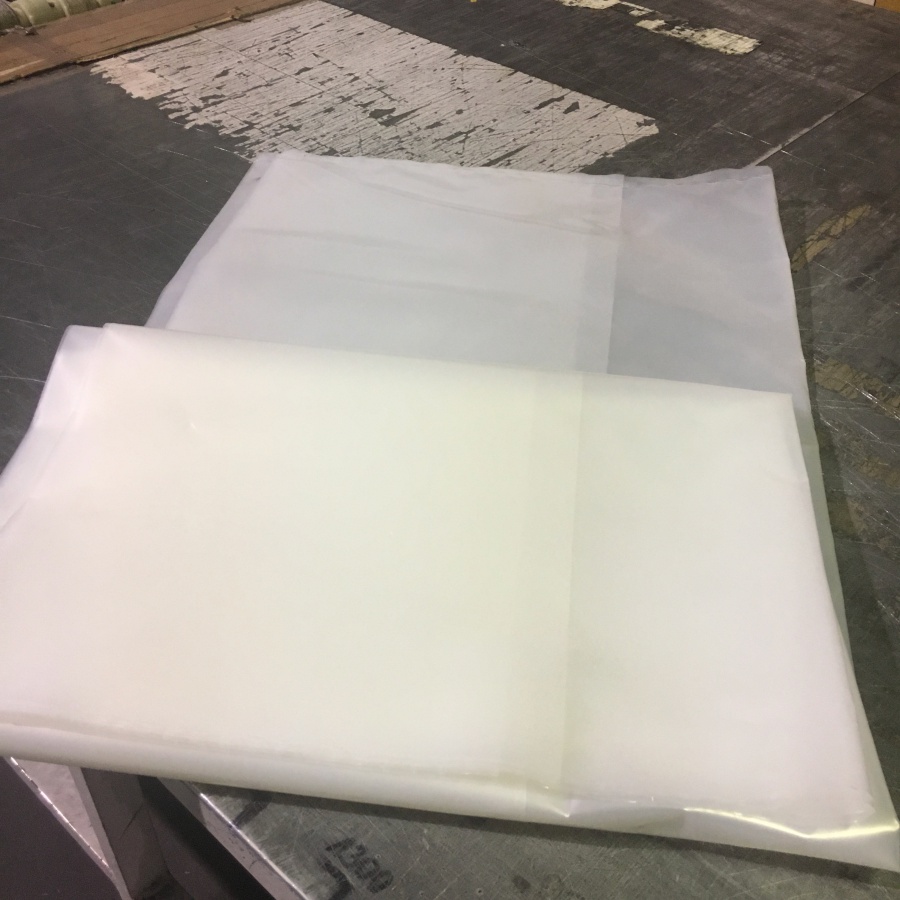
One of the most important functions of industrial packaging is to protect finished products and raw materials from external influences during storage, warehousing and transport. For goods stored on pallets, protection against dust, moisture, dirt and, in some cases, the effects of the weather is particularly important.
For this purpose, manufacturers often use LDPE pallet covers and shrink hoods, which may appear to be similar products at first glance, but there are significant differences between their operation and their areas of application.
Whilst a pallet cover is primarily used to cover and protect goods on pallets, a shrink hood shrinks around the goods when heated; thus, if designed and used correctly, it can also help to stabilise the packaging.
However, when selecting the right packaging material, it is not only the protective function that needs to be taken into account. It is important to consider the film thickness, dimensions, raw material composition, packaging technology and, of course, cost-effectiveness.
What’s more, an increasing number of industrial companies are now seeking solutions to reduce their use of virgin plastic. Certain pallet covers, for example, can be manufactured from up to 100% recycled LDPE, whilst in the case of shrink hoods, special technical requirements may necessitate a more careful selection of raw materials.
In this article, we explain the difference between pallet covers and shrink hoods, which are suitable for which applications, and what you should bear in mind before ordering industrial packaging materials.
What is a pallet cover, and what is it used for?
A pallet cover is a type of material typically made from LDPE film, which is placed over or pulled over goods on a pallet to protect them from external environmental factors.
Its primary function is to protect the products, rather than to secure the load mechanically.
Pallet covers are used in a wide range of industries, for example:
- in the manufacture of building materials,
- at logistics centres,
- in warehousing,
- when storing industrial products,
- in manufacturing plants,
- in the handling of goods in the wholesale sector.
Pallet covers can be particularly useful when goods are stored for long periods or moved in environments where they may be exposed to dust, moisture or other contaminants.
What protection does an LDPE pallet cover provide?
A well-chosen pallet cover provides effective protection in several ways.
Protection against dust and dirt
In warehouse and factory environments, products are often exposed to dust. A pallet cover can help prevent dirt from coming into direct contact with the goods.
Protection against moisture and rain
When designed correctly, LDPE film can help protect products from external moisture, for example during short-term outdoor storage or handling.
It is important to note, however, that a pallet cover alone does not necessarily ensure a complete watertight seal, particularly if the sides or underside of the load are not properly sealed.
Outdoor storage
UV-stabilised pallet covers can also be manufactured for outdoor use. The UV stabiliser can help to slow down the ageing of the film caused by exposure to sunlight.
However, the applicable outdoor service life must always be determined on the basis of the specific technical properties of the film and the environmental conditions to which it is exposed.
Why choose a recycled LDPE pallet cover?
One of the major advantages of pallet covers is that, in many cases, they do not necessarily require virgin raw materials.
Provided that the appropriate technical characteristics can be ensured, the pallet cover made from recycled LDPE regranulate can also reliably fulfil its protective function.
This can bring both economic and environmental benefits.
By using the right recycled raw materials, the demand for virgin plastic can be reduced, whilst plastic waste generated previously can be reintroduced into the economy as a useful product.
What is a shrink hood, and how does it work?
A shrink hood is a special type of plastic packaging material which, when heated using the appropriate technology, can shrink to fit the shape of the load.
Shrink hoods are typically used to protect palletised goods, to form unit loads and, in certain cases, to stabilise them.
During the shrink-wrapping process, the film is pulled around the goods placed on the pallet and then shrunk using the appropriate heat treatment.
As a result, the film fits more snugly around the load.
What are the advantages of a shrink hood?
Shrink hoods can provide an effective solution for a wide range of industrial applications.
Cargo stabilisation
Properly designed shrink-wrap packaging can help to keep products on a pallet together and ensure their stability.
Product protection
A shrink hood can protect packaged goods from dust, dirt and certain environmental factors.
Custom packaging design
The shrink hood can be adjusted to the size and shape of the product, making it suitable for various types of cargo.
Industrial packaging processes
With the right equipment and film properties, shrink hoods can also be incorporated into industrial packaging processes.
Which industries use shrink hoods?
The use of shrink hoods is particularly common in areas where heavier or palletised goods need to be packaged.
Examples of this might include:
- manufacture of building materials,
- packaging of bricks and other construction products,
- palletising of industrial products,
- protection of finished products at the manufacturing plant,
- packaging of larger unit loads.
However, the choice of the appropriate shrink hood is always based on the specific product and packaging technology.
Pallet covers or shrink hoods: what’s the difference?
The most significant difference between the two products lies in the operation and function of the packaging.
A pallet cover protects the load, while a shrink hood uses heat to conform to its shape and can also improve load stability when properly designed.
Pallet covers vs. shrink hoods: Key differences
| Criterion | Pallet cover | Shrink hood |
|---|---|---|
| Primary function | Protection against dust, dirt and moisture | Product protection and load stabilisation |
| Installation | It is pulled or placed onto the load | It is pulled over the load and then heat-shrunk |
| Heat treatment | It is not usually necessary | Required |
| Raw material | Virgin or recycled LDPE | Typically, carefully selected LDPE raw material |
| Recycled content | In many cases, as much as 100% | It depends on the technical requirements |
| Load securing | On its own, it does not generally ensure | If designed appropriately, it can contribute to |
| Machine application | There are several possible installation options | It requires specialised shrink-wrapping equipment |
| Main use | Warehousing, storage, product protection | Industrial pallet packaging, unit loads |
Making the right choice is therefore not just a question of price.
If the goods primarily require protection against dust or moisture, a suitable pallet cover may be sufficient.
However, if you also wish to ensure the stability of the load through the packaging, it is worth considering the use of shrink hoods.
What materials can be used to make pallet covers and shrink hoods?
The choice of raw material fundamentally determines the film’s properties, suitability for use and cost.
Pallet covers and shrink hoods can be made from virgin materials or, in certain cases, from recycled materials.
Primary LDPE raw material
Primary LDPE is a polyethylene raw material derived from primary production.
Its advantage is that, provided the manufacturer’s specifications are met, it offers predictable and stable performance.
Its use may be particularly important in products where the film:
- requires precise shrinkage characteristics,
- is subject to greater mechanical stress,
- requires uniform thickness and dimensional stability,
- It is used on a specialised packaging machine.
In the case of shrink hoods, therefore, products made from virgin material are often used.
PCR raw material
A PCR a Post-consumer recycled an abbreviation referring to raw material made from plastic that has been collected and recycled after consumer use.
PCR regranulate can be used in a wide range of industrial film products.
They can be a particularly good choice for pallet covers, provided that the appropriate mechanical properties and the required protective function can be ensured.
PIR raw material
PIR stands for Post-Industrial Recycled and refers to recycled plastic raw materials recovered from industrial manufacturing processes.
PIR raw material is often purer, more uniform and easier to control than PCR of mixed origin.
It can therefore be considered even for industrial packaging applications where there are higher quality requirements for raw materials.
However, the PCR or PIR designation alone does not guarantee that the material meets the required product specifications. The suitability of the finished film must always be assessed on the basis of its specific intended use.
Why can pallet covers often be made entirely from recycled materials?
In the case of pallet covers, there is often no need for the sort of specialised material properties required, for example, in shrink films.
If the primary purpose of the product is to provide protection against dust, dirt and moisture, the required film can also be produced using recycled LDPE regranulate of a suitable quality.
In practice, this means that, for certain types of pallet covers, it is even possible to use entirely recycled raw materials.
This can be particularly beneficial for companies that:
- want to reduce their use of virgin plastic,
- use large quantities of pallet covers,
- are looking for more sustainable packaging solutions, or
- have set corporate targets for recycled content.
However, choosing the right regranulate is crucial here too, as the pallet cover must provide adequate protection during actual use.
Why does a shrink hood require a more careful choice of raw materials?
For shrink hoods, raw material quality is particularly important, as the film must maintain its performance throughout the heat-shrinking process.
During the shrinking process, any defects or dirt in the film can cause significant problems.
For example, if the regranulate contains excessive foreign matter, the film may develop the following defects during shrinking:
- develop holes or leaks,
- tear,
- shrink unevenly,
- lose its required mechanical properties, or
- fail to provide adequate protection for the load.
Therefore, the use of recycled raw materials in shrink hoods is not out of the question, but it requires more thorough raw material analysis and production testing.
An experienced LDPE film manufacturer can help determine the raw material composition and film thickness required for a particular application.
What thickness of pallet cover or shrink hood should we choose?
The thickness of the film is one of the most important technical parameters that must be specified when ordering industrial packaging materials.
Thickness is typically given in microns.
Several factors influence the ideal thickness.
The size and weight of the cargo
Heavier or larger loads may require different mechanical properties, particularly when using shrink hoods.
The surface of the product
Sharp edges, rough surfaces and irregularly shaped products can place additional stress on the film.
Storage conditions
Indoor storage may require different characteristics to outdoor storage, where the packaging may be exposed to sunlight, wind and rain.
Packaging technology
For shrink hoods, the required film thickness depends on both the shrinking equipment used and the heat-treatment parameters.
The quality of the raw materials
The mechanical properties of films made from virgin and recycled LDPE raw materials may differ; therefore, it is not sufficient to base a decision solely on the micron value.
The aim is not to choose the thickest possible film, but to strike a balance between adequate product protection and economical use of materials.
Custom pallet covers: why is the correct size important?
In industrial applications, standard-sized packaging materials often do not fit the load precisely.
A pallet cover that is too large may result in unnecessary use of raw materials, whilst one that is too small will not provide adequate coverage and is more likely to be damaged during fitting.
During custom manufacturing, several parameters can be specified:
- the width of the pallet cover,
- the length of the pallet cover,
- the required height,
- the thickness of the film,
- the composition of the raw materials,
- recycled content,
- the colour,
- the addition of additives,
- the packaging.
To ensure the correct sizing, it is important to know the exact dimensions of the pallet and the products placed on it.
On this basis, an experienced manufacturer can recommend a solution that provides adequate protection whilst minimising unnecessary material usage.
What additives can be used in the manufacture of pallet covers?
Different industrial applications may impose specific requirements on packaging materials.
For this reason, pallet covers can, in certain cases, be manufactured using special additives.
UV-stabilised pallet cover
When stored outdoors, the film may be exposed to significant sunlight.
A UV stabiliser can help to slow down the ageing of the material, thereby extending the film’s service life in outdoor environments.
Antistatic pallet cover
In certain industrial applications, it may be important to minimise electrostatic charging.
The addition of antistatic additives can be a useful solution in such cases.
However, in specialised electronic or potentially explosive environments, the appropriate electrical properties must be verified separately; the mere addition of antistatic additives does not, in itself, guarantee general safety compliance.
Anti-corrosion additive
In certain cases, packaging for metal products may also need to offer protection against corrosion.
In such cases, film fitted with a suitable, certified anti-corrosion system can help to protect the products.
The necessary additives must always be determined on the basis of the specific intended use and technical requirements.
How can the cost of industrial packaging be reduced by using pallet covers?
When large quantities of industrial packaging materials are used, even minor optimisations can lead to noticeable savings.
Many companies have been using the same pallet covers – in terms of size, thickness or material composition – for many years.
However, this does not mean that the solution chosen previously remains the best one.
There are several ways to reduce packaging costs.
Through size optimisation
Knowing the exact dimensions of the load helps to avoid using film that is too large.
Through thickness optimisation
Given the required mechanical properties, it is possible to assess whether a thinner film would be sufficient.
Made from recycled materials
Where the product’s function permits, the primary raw material may be partially or entirely replaced with recycled LDPE regranulate.
By reviewing packaging technology
In certain cases, it is worth considering whether a shrink hood is actually necessary for the task in question, or whether a simpler pallet cover would provide adequate protection.
However, cost savings must not come at the expense of product protection. The optimisation of packaging materials must always be based on technical considerations.
Pallet cover or shrink hood: which is the right option?
To make the right choice, it is worth clarifying a few basic questions.
1. What is the primary purpose of the packaging?
If protection is required solely against dust, dirt or moisture, a standard pallet cover may be sufficient.
If stabilising the load is also an objective, it is worth considering the use of shrink hoods.
2. Is it designed for indoor or outdoor use?
When storing outdoors, UV stabilisation, weather conditions and the correct film thickness may be important.
3. How big is the load?
The size of the pallet and the products stored on it essentially determine the required film size.
4. What sort of mechanical stress can be expected?
The surface, weight, method of handling and storage conditions of the products all influence the choice of suitable packaging material.
5. Are there any requirements regarding recycled content?
In the case of pallet covers, a high proportion of recycled raw materials can often be used, whilst shrink hoods require more thorough technical testing.
6. What packaging technologies are available?
If the company does not have suitable shrink-wrapping equipment, the use of shrink hoods may require further investment or technological modifications.
Clarifying these issues helps to ensure that procurement is not based solely on price.
Why is consultation with the manufacturer important?
A common problem when selecting industrial packaging materials is that purchasers request quotations based on the specifications of a product they have used previously.
However, this does not necessarily lead to the most cost-effective solution.
It is possible, for example, that the pallet cover used previously:
- too big,
- unreasonably thick,
- is made from raw materials that are more expensive than necessary,
- not properly fortified,
- or does not fit the current load exactly.
An experienced LDPE film manufacturer can help you determine the required dimensions, thickness and raw material composition.
Custom manufacturing may provide an opportunity to explore the use of recycled raw materials and to optimise the use of materials in packaging.
This is particularly important for larger orders, where even minor changes can result in significant annual cost savings.
Recycled LDPE Pallet Covers and Sustainability
More and more companies are looking for ways to reduce their use of virgin plastic.
Pallet covers made from recycled LDPE can be a good option, provided the recycled material meets the required quality standards.
But sustainability is not just about using recycled plastic.
Other factors matter too.
These include:
- choosing the right size,
- using only as much material as necessary,
- ensuring the film is strong enough for the job,
- protecting the goods during storage and transport,
- reducing waste.
If the film is too thin or unsuitable for the application, it can tear and leave the goods unprotected, leading to damaged products and more waste.
At Manitox, we help our customers find the right pallet cover for their needs, balancing recycled content, reliable protection and cost-effectiveness. This way, you can reduce your use of virgin plastic without compromising the protection your products need.
Large-scale production of custom pallet covers and shrink hoods
Custom manufacturing can be particularly advantageous for industrial and wholesale applications.
The customer can specify the required product parameters precisely, or work with the manufacturer to define them.
When requesting a quote, it is worth having the following to hand:
- the dimensions of the cargo,
- the intended use,
- the required film thickness, if known,
- the conditions of indoor or outdoor use,
- the planned order quantity,
- the requirements relating to any recycled content,
- additive requirements,
- information relating to packaging technology.
As mentioned in a previous technical interview, the manufacturer’s general minimum order quantity is 500 kg per product type, although exceptions may apply in certain sampling situations or special cases.
The production and delivery lead time is typically 3–4 weeks, but this may vary depending on current capacity, the product type and the quantity ordered.
For larger, regular orders, it is therefore worth considering a long-term partnership with suppliers and a pre-planned delivery schedule.
Summary: which is the better choice?
Both pallet covers and shrink hoods can play an important role in industrial packaging, but they are designed for different purposes.
Traditional pallet covers are primarily designed to protect palletised goods, for example against dust, dirt and moisture. In many cases, they can be manufactured from recycled LDPE, with a recycled content of up to 100%.
Unlike a standard pallet cover, a shrink hood moulds itself around the load when heated and can also help keep it stable. The film must withstand the shrinking process, so choosing the right raw material is essential.
A good decision, therefore, does not depend solely on the price or thickness of the film. The type and size of the load, the storage conditions, the packaging technology and the required level of protection are all important factors.
Through appropriate consultation with the manufacturer, bespoke sizing and the selection of raw materials, it is possible to develop an industrial packaging solution that simultaneously ensures reliable product protection, economical use of materials and, where possible, more sustainable operations.
Frequently Asked Questions
What is the difference between a pallet cover and a shrink hood?
A pallet cover is primarily designed to protect palletised goods from dust, moisture and dirt. When heated, a shrink hood conforms to the shape of the load and, if designed correctly, can also help to stabilise it.
What is an LDPE pallet cover used for?
LDPE pallet covers can be used to protect industrial products, building materials and palletised goods during warehousing, storage or certain transport processes.
Can pallet covers be made entirely from recycled materials?
Yes. Certain pallet covers can be manufactured from recycled LDPE regranulate of suitable quality, with a recycled content of up to 100%.
Can a shrink hood be made from recycled materials?
In certain cases, yes; however, due to shrinkage characteristics and mechanical requirements, the quality of the raw material, as well as moulding and testing, are particularly important.
What thickness of pallet cover should we choose?
The appropriate thickness depends on the size of the load, the mechanical load, the storage conditions and the required protective function.
Can this pallet cover be used for outdoor storage?
Yes, but for outdoor use, factors such as UV radiation, precipitation, wind loads and the duration of storage must be taken into account. If necessary, UV-stabilised film can be used.
Why is it important for the pallet cover to be the correct size?
A pallet cover that is too large may result in unnecessary use of raw materials, whilst one that is too small may not provide adequate coverage or may be more prone to damage during use.
Is special equipment required to use shrink hoods?
Yes, the correct application of shrink hoods generally requires a shrink-wrapping machine or another heat-treatment solution compatible with the packaging technology.
What materials can be used to make a pallet cover?
Pallet covers can be manufactured from virgin LDPE, PCR or PIR recycled regranulate, or a suitable combination of these.
Is it possible to order pallet covers in custom sizes?
Yes. For larger orders, it is possible to customise the width, length, height, thickness, raw material composition and additives of the pallet cover.
Looking for the right pallet covers or shrink hoods for your business?
At Manitox, we help you find the right LDPE packaging solution for your products and requirements.
Whether you need standard pallet covers, shrink hoods, custom sizes or covers made from recycled materials, we can help you choose the right option.
Contact us for a tailored quote for your industrial pallet covers or shrink hoods. Request a quote